



You spent good money on those BMW wheels. Maybe they’re the factory M Sport double-spokes. Maybe you upgraded to a set of forged monoblocks. Either way, you didn’t buy them so they could disappear under a film of black brake dust three days after washing your car.
If you own a BMW 3 Series, you already know the struggle. That dark, gritty residue coating your front wheels is brake dust, and BMWs produce more of it than almost anything else on the road. It’s not a defect. It’s a side effect of how BMW engineers spec their brake pads from the factory. But that doesn’t mean you have to live with it.
This guide covers the best low dust brake pads for BMW 3 Series models, explains why your car creates so much dust in the first place, and walks through the specs and details you need for both F30 and G20 generations.
!BMW 3 Series wheel with visible brake dust buildup
Alt text: BMW 3 Series front wheel showing heavy brake dust buildup on spokes and barrel
Why BMWs Are Brake Dust Magnets
Your BMW isn’t broken. It’s German-engineered.
European automakers spec brake pads differently than their Japanese and American counterparts. BMW, Audi, Mercedes, and Porsche all use aggressive semi-metallic pad compounds from the factory. These pads have a high metal content (iron, copper, steel fibers) that delivers strong initial bite and consistent stopping power at the high speeds common on unrestricted sections of the Autobahn.
The trade-off? That aggressive metallic compound sheds material every time you hit the brakes. The fine metal particles are what coat your wheels in that familiar dark film. OEM BMW pads prioritize raw stopping performance above all else. Dust, noise, pad life… those are secondary concerns.
European braking standards (ECE R90) also require pads to match or exceed specific friction thresholds that are generally higher than what you’ll find in North American testing standards. Manufacturers meet those thresholds with harder, more abrasive formulations. Great for stopping from 150 mph on the A5. Not so great for keeping your 19-inch wheels clean on your commute.
The good news: aftermarket ceramic brake pads have come a long way. Modern ceramic compounds can deliver strong braking performance while producing a fraction of the dust. The key for BMW owners is choosing a pad specifically formulated for European brake systems, not a generic ceramic pad designed for a Camry.
BMW 3 Series Brake Specs by Generation
Getting the right parts means knowing your generation. BMW changed brake sizes and configurations between the F30 and G20, and trim level matters too.
F30/F31 (2012-2018)
The sixth-generation 3 Series covered a lot of ground. Here’s what you need to know about the brakes:
328i / 330i (Standard Brakes)
- Front rotors: 312mm (12.28 inches) vented
- Rear rotors: 300mm (11.81 inches) solid
- Front caliper: Single-piston floating
- Pad wear sensors: Front and rear (driver side)
335i / 340i (Standard Brakes)
- Front rotors: 340mm (13.39 inches) vented
- Rear rotors: 330mm (12.99 inches) vented
- Front caliper: Single-piston floating (larger than 328i/330i)
- Pad wear sensors: Front and rear (driver side)
M Sport Brake Package
The M Sport package on F30 models could include upgraded brakes with larger rotors and different calipers, depending on the specific option codes. If your car has blue M Sport calipers, you likely have the larger rotor setup regardless of engine. Check your rotor diameter before ordering.
G20/G21 (2019-2025)
BMW refined the brake setup for the seventh-generation 3 Series. Rotor sizes grew slightly, and the M340i got a meaningful upgrade over the base 330i.
330i (Standard Brakes)
- Front rotors: 330mm (12.99 inches) vented
- Rear rotors: 300mm (11.81 inches) solid
- Front caliper: Single-piston floating
- Pad wear sensors: Front and rear (driver side)
M340i (Standard Brakes)
- Front rotors: 348mm (13.70 inches) vented
- Rear rotors: 345mm (13.58 inches) vented
- Front caliper: Four-piston fixed (M Sport brakes standard)
- Pad wear sensors: Front and rear (driver side)
M Sport Brake Package (G20 330i)
Available as an option on the 330i, this package bumps up rotor sizes and adds the four-piston front calipers from the M340i. Again, measure your rotors or check your build sheet if you’re unsure.
A Note on M3 Models (F80/G80)
The BMW M3 is a different animal entirely. Both the F80 (2015-2018) and G80 (2021+) use significantly larger brakes with multi-piston calipers, and the G80 offers optional carbon-ceramic rotors. If you’re driving an M3, the pad recommendations in this guide won’t apply. M3 brakes need M3-specific parts.
Best Low-Dust Brake Pads for BMW 3 Series
Not all low-dust pads are created equal, and not all of them work well on European cars. BMW brake systems run hotter, demand higher friction coefficients, and have tighter tolerances than most domestic vehicles. Here are the best options depending on how you drive.
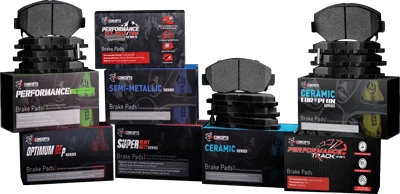
Best Overall Low-Dust: R1 CERAMIC European Series
Best for: 330i and M340i owners who want clean wheels and confident daily braking.
The R1 CERAMIC European Series pads were designed from the ground up for European vehicles like BMWs. That distinction matters. These aren’t generic ceramic pads with a “European” label slapped on the box. The friction compound is formulated to meet the higher friction demands of European brake systems while producing dramatically less dust than OEM semi-metallic pads.
You’ll notice the difference immediately. Where your factory pads would coat your wheels in dark residue within a few days of washing, the European Series pads produce a light, tan-colored dust that’s far easier to clean and much less noticeable. The fine ceramic particles don’t bond to wheel finishes the way metallic dust does.
Braking performance stays strong. Initial bite is slightly different from the grabby OEM pads (ceramic compounds build friction progressively rather than biting hard right away), but stopping distances remain excellent. Most owners adjust within the first few drives and actually prefer the more linear pedal feel.
Noise is another benefit. Semi-metallic OEM pads tend to squeal, especially in cold, damp conditions. The ceramic compound runs significantly quieter across all temperatures.
Daily Driving Alternative: R1 CERAMIC Series
Best for: Budget-conscious 3 Series owners who want low dust without the European-specific premium.
The standard R1 CERAMIC Series is a solid low-dust option for BMW 3 Series models, especially for the 330i and 328i with standard (non-M Sport) brakes. These pads use a quality ceramic compound that cuts brake dust by 50-70% compared to OEM semi-metallic pads.
The difference between this and the European Series comes down to the friction formulation. The standard Ceramic Series is optimized for a broader range of vehicles, while the European Series is tuned specifically for the higher operating temperatures and friction requirements of European brake systems. For casual daily driving, especially in the 328i and 330i, the standard Ceramic Series does a great job at a lower price point.
If you’re doing mostly city and suburban driving without pushing your brakes hard, these are a smart pick. If you drive more aggressively or have the M340i with its larger, hotter-running brakes, step up to the European Series.
Spirited Driving / M Sport: R1 PERFORMANCE Sport
Best for: M340i owners, M Sport brake packages, and anyone who drives their 3 Series like it was meant to be driven.
Let’s be honest. Some of you didn’t buy a BMW to cruise. You take back roads, you brake late into corners, and your pads see real heat. For that kind of driving, pure ceramic pads can fade under sustained high-temperature use.
The R1 PERFORMANCE Sport pads bridge the gap. They produce noticeably less dust than OEM semi-metallic pads but use a friction compound that handles high temperatures better than full ceramic formulations. You’ll still see some dust on your wheels (more than the ceramic options), but it’s a significant improvement over the factory pads that turn your wheels black.
These are especially well-suited for the M340i and any F30/G20 with the M Sport brake package. The larger rotors and more aggressive calipers on those setups generate serious heat during spirited driving, and the Performance Sport compound is built to handle it without fade.
For a deeper comparison of pad types, check out this breakdown of ceramic vs. semi-metallic vs. organic brake pads.
Best BMW 3 Series Brake Rotors
While you’re swapping pads for a low-dust option, it’s worth looking at your rotors too. If they’re scored, warped, or at minimum thickness, new pads on old rotors won’t perform their best.
Stock Replacement: R1 Blank Rotors with Geomet Coating
The R1 Blank Rotors are a direct OEM-size replacement with one major advantage: Geomet coating. This zinc-aluminum coating protects the non-friction surfaces (the hat, edges, and vanes) from rust and corrosion.
Why does that matter for BMWs specifically? Because BMW wheels are designed with open spokes that show off the brakes. Rusty rotor hats look terrible behind those wheel designs. Geomet-coated rotors stay clean and silver instead of developing that ugly orange crust.
They’re the right choice if your current rotors are worn out and you want a clean, factory-spec replacement that looks great behind your wheels.
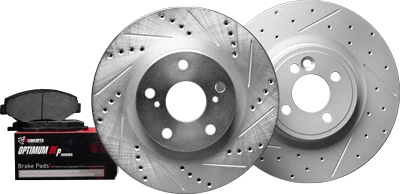
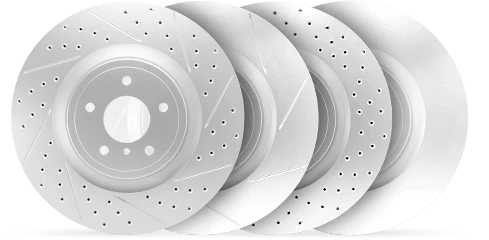
All-Around Upgrade: R1 eLine Drilled and Slotted Rotors
If you want better performance and better looks, the R1 eLine Drilled and Slotted rotors are the upgrade to consider. The drilled holes and machined slots serve real functional purposes: they channel away water, gas, and debris from the pad-to-rotor contact surface. That translates to better wet-weather braking and more consistent performance during spirited driving.
They also look fantastic behind BMW spoke designs. If aesthetics matter to you (and you’re reading a guide about keeping your wheels clean, so they probably do), drilled and slotted rotors add a level of visual detail that blank rotors can’t match.
For a detailed comparison of rotor styles, read this guide to drilled vs. slotted rotors.
BMW-Specific Brake Considerations
BMWs have a few quirks that make brake jobs different from your average car. Miss any of these and you’ll end up with warning lights, poor performance, or a second trip to the parts store.
Pad Wear Sensors Are Mandatory
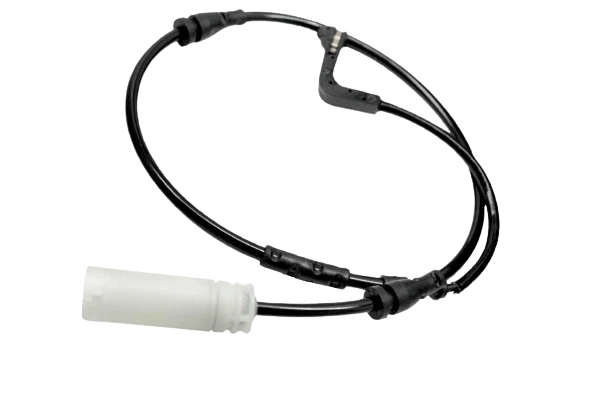
BMW uses electronic brake pad wear sensors, and they’re not optional. A small wire embedded in the brake pad contacts the rotor surface when the pad wears down to a certain thickness, triggering a warning on your dashboard. These sensors are single-use. Once they’ve been triggered (or even if they haven’t), you need to replace them every time you change pads.
There’s one sensor per axle, always on the driver’s side. Front and rear. If you skip them, your iDrive will throw a brake wear warning that won’t go away. Budget for two sensors per brake job (one front, one rear).
Brake Service Interval Reset
After changing pads and rotors, you need to reset the brake service indicator in BMW’s iDrive system. This isn’t just a reminder light. The system tracks pad wear based on the sensor input and driving conditions. If you don’t reset it, the car will continue counting down from the old pad’s wear data and give you premature warnings.
On most F30 and G20 models, you can reset this through the vehicle settings menu in iDrive. Some owners use a BMW-specific scan tool (like BimmerLink or ISTA) for a more complete reset. Your shop should handle this as part of the brake service.
M Sport vs. Base Brake Differences
This bears repeating: M Sport brakes are physically different from base model brakes. Larger rotors, different calipers, different pad shapes. Parts are not interchangeable between the two setups. If your 330i has the optional M Sport brake package, you need to order parts for that specific configuration, not the base 330i.
Why European-Formula Pads Matter
Generic ceramic pads designed for domestic vehicles may not meet the friction requirements of BMW brake systems. European calipers are designed to work with pads that have a specific friction coefficient range. Drop below that range and you’ll feel it as longer stopping distances, a soft pedal, or poor cold-weather bite.
European-formula pads are tested against ECE R90 standards and matched to the friction characteristics these brake systems expect. It’s not marketing fluff. It’s engineering.
The Bedding Process
New pads and rotors need to be bedded in properly. This transfers an even layer of pad material onto the rotor surface, creating a consistent friction interface. Skip this step and you’ll get uneven deposits that cause vibration, noise, and reduced performance.
The bedding process involves a series of moderate stops from speed, followed by a cooldown period. It takes about 15-20 minutes and makes a real difference in how your new brakes feel and perform. Follow this complete brake bedding procedure guide for step-by-step instructions.
Quick Reference: BMW 3 Series Low-Dust Brake Pad Recommendations
| Driving Style | Recommended Pad | Dust Level | Best For |
|---|---|---|---|
| Daily commuting (330i/328i) | R1 CERAMIC European Series | Very Low | Clean wheels, quiet stops, everyday driving |
| Budget daily (330i/328i) | R1 CERAMIC Series | Low | Good dust reduction at a lower price |
| Spirited / M Sport / M340i | R1 PERFORMANCE Sport | Low-Moderate | High-temp capability with less dust than OEM |
| Track / extreme performance | OEM semi-metallic or R1 PERFORMANCE Sport | High | Maximum stopping power (dust is secondary) |
| BMW 3 Series Model | Front Rotor Size | Rear Rotor Size |
|---|---|---|
| F30 328i/330i (standard) | 312mm | 300mm |
| F30 335i/340i (standard) | 340mm | 330mm |
| G20 330i (standard) | 330mm | 300mm |
| G20 M340i (standard) | 348mm | 345mm |
Not sure if your pads need replacing? Here’s how to tell when it’s time to replace your brake pads.
Frequently Asked Questions
Will ceramic pads reduce stopping power on my BMW?
Modern ceramic compounds designed for European vehicles deliver strong stopping performance that’s very close to OEM semi-metallic pads. You may notice a slightly different pedal feel (ceramic pads build friction progressively rather than biting hard immediately), but actual stopping distances remain comparable. The key is choosing a pad rated for European brake systems, not a generic ceramic pad.
How often do BMW brake pads need replacing?
BMW brake pads typically last 25,000 to 50,000 miles depending on driving style, pad compound, and whether you’re looking at front or rear. Front pads wear faster because they handle roughly 60-70% of the braking force. Aggressive drivers and city commuters will hit the lower end of that range. Highway cruisers will get more life. Ceramic pads generally last longer than semi-metallic pads, so switching to low-dust pads may actually extend your replacement interval. For a full breakdown of replacement timing and costs, check out this guide to brake job costs.
Do I need to replace BMW brake pad sensors every time?
Yes. Every time. BMW pad wear sensors are designed for single use. The wire in the sensor wears down along with the pad, and once it’s been in contact with the rotor surface, it can’t accurately measure pad thickness again. They’re inexpensive (usually $10-$20 each), and you need one per axle. Don’t skip them.
Are aftermarket pads as good as BMW OEM?
Quality aftermarket pads from reputable manufacturers can match or exceed OEM performance in specific areas. OEM BMW pads are optimized for maximum stopping power with dust and noise as secondary concerns. Aftermarket options let you prioritize differently. If clean wheels and quiet operation matter to you, a European-formula ceramic pad will outperform OEM in those categories while maintaining strong braking performance. The savings are significant too. OEM BMW pads carry a steep dealer markup.
Will low-dust pads void my BMW warranty?
No. The Magnuson-Moss Warranty Act prevents manufacturers from voiding your warranty simply because you used aftermarket parts. A dealer would have to prove that a specific aftermarket part directly caused a failure in order to deny a warranty claim. Millions of BMW owners run aftermarket brake pads without warranty issues. Just keep your receipts and maintenance records.
Keep Your BMW Wheels Clean for Good
Brake dust doesn’t have to be part of the BMW ownership experience. The right set of low dust brake pads for your BMW 3 Series can keep your wheels looking fresh between washes while still delivering the braking confidence you expect from a driver’s car.
Whether you’re running a daily-driven 330i or pushing an M340i through canyon roads, there’s a pad compound that fits your driving style without turning your wheels into a dust magnet.
Ready to find the right low-dust brake setup for your specific BMW 3 Series? Shop R1 Concepts Brake Kits for BMW 3 Series and get everything you need in one box: pads, rotors, and hardware matched to your exact model.