


The Mustang has always been about going fast. But going fast only matters if you can stop. Ford knew this, which is why every generation of the Mustang got progressively better braking hardware from the factory. The problem? “Better” is relative. Factory brakes are designed to satisfy the widest possible range of buyers, from the person who wanted a cool-looking daily driver to the weekend warrior who hits the track twice a month.
That gap between “adequate for everyone” and “dialed in for you” is where the right brake pad and rotor combination makes all the difference. Whether you’re autocrossing an EcoBoost, daily driving a GT, or pushing a Dark Horse on a road course, the best brakes for Ford Mustang builds depend entirely on how you use the car.
This guide covers exact brake specs for every S550 and S650 variant, recommended pads and rotors for each use case, and the fitment details that trip people up (especially around Performance Pack and Brembo-equipped models).
Mustang Brake Specs by Generation
Getting the right parts means knowing exactly what hardware your car left the factory with. Ford used significantly different brake packages across trim levels and option packages, and the differences aren’t just cosmetic. Rotor diameter, caliper piston count, and pad size all change depending on your specific build.
S550 Mustang (2015-2023)
The S550 ran for nearly a decade and came with a wide spread of brake configurations. Here’s the breakdown:
Base EcoBoost and GT (no Performance Pack):
- Front rotors: 321mm (12.6 inches) on EcoBoost, 352mm (13.9 inches) on GT
- Rear rotors: 300mm (11.8 inches) on EcoBoost, 330mm (13.0 inches) on GT
- Calipers: Single-piston sliding calipers front and rear
- Lug pattern: 5×114.3mm
The base GT brakes are decent for street driving but show their limits quickly under repeated hard stops. The EcoBoost’s smaller rotors reflect the lighter engine up front, but they can feel undersized if you’re pushing the car hard through corners.
Performance Pack 1 (PP1):
- Front rotors: 380mm (15.0 inches)
- Rear rotors: 330mm (13.0 inches)
- Front calipers: 4-piston Brembo fixed calipers
- Rear calipers: Single-piston sliding calipers
The PP1 package was a massive jump in braking capability. Those 380mm front rotors with Brembo calipers brought serious stopping power and much better heat management. If your GT has the PP1, you already have solid hardware to work with.
Performance Pack 2 (PP2):
- Front rotors: 380mm (15.0 inches)
- Rear rotors: 330mm (13.0 inches)
- Front calipers: 6-piston Brembo fixed calipers
- Rear calipers: Single-piston sliding calipers
PP2 stepped up to six-piston Brembo calipers up front. Same rotor sizes as PP1 but with more clamping force from the extra pistons. This package also came with more aggressive factory pads and the MagneRide suspension.
GT350 and GT500:
- Front rotors: 394mm (15.5 inches) on GT350, 420mm (16.5 inches) on GT500
- Rear rotors: 380mm (15.0 inches) on GT350, 370mm (14.6 inches) on GT500
- Front calipers: 6-piston Brembo (GT350), 6-piston Brembo (GT500)
The Shelby models got the biggest brakes in the S550 lineup. The GT500’s 420mm front rotors are absolutely massive, and they need to be. You’re scrubbing speed from a 760-horsepower supercharged V8. These cars demand track-capable brake compounds if you plan to use them anywhere near their potential.
S650 Mustang (2024+)
Ford’s newest Mustang brought a fresh platform with updated brake hardware across the board.
Base EcoBoost and GT:
- Front rotors: 330mm (13.0 inches) on EcoBoost, 352mm (13.9 inches) on GT
- Rear rotors: 305mm (12.0 inches) on EcoBoost, 330mm (13.0 inches) on GT
- Calipers: Single-piston sliding calipers front and rear
- Lug pattern: 5×114.3mm
Similar sizing to the outgoing S550 base models. Perfectly fine for street duty but limited for aggressive driving.
Dark Horse:
- Front rotors: 390mm (15.4 inches)
- Rear rotors: 355mm (14.0 inches)
- Front calipers: 6-piston Brembo fixed calipers
- Rear calipers: 4-piston Brembo fixed calipers
The Dark Horse is Ford’s track-focused GT replacement for the GT350. It gets Brembo calipers on all four corners for the first time in a non-Shelby Mustang. That rear 4-piston Brembo setup is a significant upgrade over the single-piston sliders found on every other variant. This car was built with track days in mind from the start.
Best Mustang Brake Pads by Use Case
The right pad compound depends on one thing: how hard you’re going to push the car. A pad that’s perfect for commuting will smoke and fade on a track. A pad that’s amazing at 800 degrees will make terrible noise and barely stop you at 150 degrees on a cold morning. Matching the pad to your actual use case is everything. For a full breakdown of pad materials, check out our guide on ceramic vs. semi-metallic vs. organic brake pads.
Daily Driving: R1 CERAMIC Series
Best for: EcoBoost and GT owners who commute, cruise, and want clean wheels.
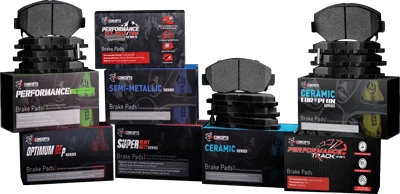
The R1 CERAMIC Series pads are the answer for Mustang owners who want smooth, quiet stops and minimal brake dust. Ceramic compounds keep your wheels looking clean (huge deal if you’re running dark or polished aftermarket wheels on your Mustang). They deliver predictable, linear pedal feel in everyday driving conditions.
These pads operate best in the temperature range you’ll see during normal street driving. They’re not built for track abuse, and that’s perfectly fine. Most Mustangs spend 95% of their life on public roads, and ceramic pads are exactly what that kind of driving demands.
Spirited Street Driving: R1 PERFORMANCE Sport
Best for: GT and Dark Horse owners who push the car hard on canyon roads, backroads, and spirited weekend drives.
The R1 PERFORMANCE Sport pads bridge the gap between pure street and pure track. They bite harder than ceramics and handle higher temperatures without fading. If you like to brake late, drive aggressively on twisty roads, or just want more confidence when you stand on the brakes from triple-digit speeds, these are the pad.
They produce a bit more dust and noise than ceramics. That’s the nature of a more aggressive compound. But the tradeoff in stopping power and heat tolerance is immediately noticeable the first time you push the car.
Track Days and Road Course: R1 PERFORMANCE Track
Best for: Dedicated track use, road course events, and time attack builds.
If you’re running your Mustang at the track, you need pads that operate in the extreme heat range that sustained lapping produces. The R1 PERFORMANCE Track pads are formulated for exactly this. They need heat to work properly, which means they won’t perform well on a cold morning commute. These are for dedicated track use.
Swap them on before your track day and swap your street pads back on when you load up the trailer (or drive home, depending on how brave you are). Running track pads on the street is a recipe for poor cold bite, excess noise, and accelerated rotor wear during normal driving. Keep them separated.
For PP1, PP2, GT350, GT500, and Dark Horse owners running HPDE events, these pads paired with quality brake fluid will transform your confidence under braking into heavy braking zones.
AutoX, HPDE, and Mixed Use: R1 PERFORMANCE Sport
Best for: Autocross competitors, HPDE beginners and intermediates, and drivers who want one pad for spirited street and occasional track sessions.
The R1 PERFORMANCE Sport pads pull double duty here. They have enough cold bite to work on the street and enough heat capacity to survive a 20-minute HPDE session or an autocross run without significant fade. For most enthusiasts who do a mix of aggressive street driving and a handful of events per year, this is the most practical single-pad solution.
Best Mustang Brake Rotors by Use Case
Your rotor choice controls how efficiently heat is managed and dissipated. The right rotor paired with the right pad compound creates a braking system that works together instead of fighting itself. Our drilled vs. slotted rotors comparison goes deeper into the engineering behind each design.
Stock Replacement: R1 Blank Rotors with Geomet Coating
Best for: Replacing worn factory rotors on daily-driven Mustangs.
R1 blank rotors match OEM specs and deliver smooth, quiet performance for everyday driving. The real advantage here is the Geomet anti-corrosion coating. Factory rotors develop ugly rust bloom on the hats and edges within weeks, especially if your Mustang sits outside or lives in a region with road salt. Geomet-coated rotors resist that corrosion and look significantly better behind open-spoke wheels.
Pair these with R1 CERAMIC Series pads for a clean, quiet, long-lasting daily setup.
Street Performance: R1 eLine Drilled and Slotted Rotors
Best for: Spirited street drivers who want improved cooling, wet-weather performance, and an aggressive look.
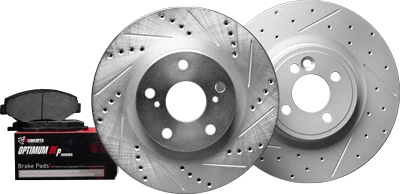
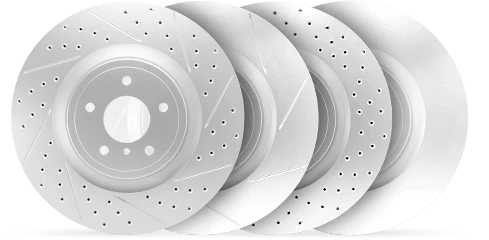
The R1 eLine drilled and slotted rotors combine cross-drilled holes for heat venting and water evacuation with slots that keep the pad surface fresh and prevent gas buildup. They look incredible behind the wheel of a Mustang (let’s be honest, aesthetics matter on this car). But the performance benefit is real too. Better cooling means more consistent stops during aggressive street driving.
These are the most popular rotor choice for Mustang owners doing a ford mustang brake upgrade on a car that splits time between daily driving and spirited weekend use.
Track and Heavy Use: R1 Slotted Rotors
Best for: Track days, HPDE, road course events, and any sustained high-heat braking.
For dedicated track use, R1 slotted rotors (slots only, no drilled holes) are the right call. Drilled holes create stress risers in the rotor that can develop into cracks under the extreme and repeated thermal cycling that track use produces. Slots provide the gas-venting and pad-freshening benefits without introducing those weak points.
If your Mustang sees regular track time, especially PP1, PP2, GT350, or Dark Horse models with big Brembo setups, slotted rotors paired with R1 PERFORMANCE Track pads give you a braking system built for the punishment of repeated high-speed stops.
Mustang-Specific Considerations
Performance Pack Brake Differences
This is where fitment gets tricky. A base GT, a PP1 GT, and a PP2 GT all wear different brake hardware. The calipers, rotor sizes, and pad shapes are different between these packages. When ordering mustang brake pads and rotors, you absolutely must know which brake package your car has. “2019 Mustang GT” isn’t specific enough. You need “2019 Mustang GT with Performance Pack 1” or “without Performance Pack.”
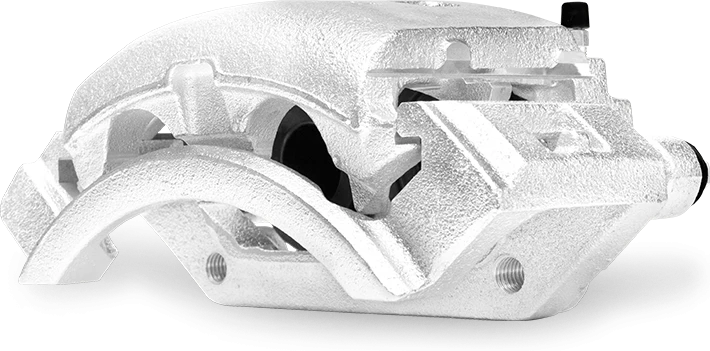
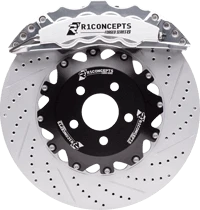
If you’re not sure which package you have, look at the front calipers. Base models have a sliding single-piston caliper. PP1 cars have a 4-piston Brembo caliper. PP2 cars have a 6-piston Brembo caliper. The Brembo calipers also have the Brembo logo cast right into them, so they’re easy to identify.
Brembo Caliper Fitment Notes
Brembo-equipped Mustangs (PP1, PP2, GT350, GT500, Dark Horse) require pads specifically designed for their caliper shape and piston configuration. Standard Mustang GT pads will not fit a Brembo caliper. Always confirm your exact caliper type when ordering. This is the single most common fitment mistake on Mustang brake orders.
Track Day Brake Fluid
If you’re tracking your Mustang, upgrade your brake fluid to a high-temperature DOT 4 racing fluid. Factory brake fluid boils at temperatures that track driving easily reaches, and boiled fluid means a spongy pedal or complete pedal loss. Flush the system with quality high-temp fluid before your first session and bleed again if the pedal starts to feel soft during the day.
Bedding Your New Brakes
New pads and rotors need a proper break-in procedure. This isn’t optional. Skipping the bedding process leads to uneven pad deposits on the rotor surface, which causes vibration, noise, and reduced stopping power. It takes about 15 minutes and makes a massive difference in how your new brakes perform and how long they last. Follow our complete brake bedding procedure guide for the step-by-step process.
Quick Reference: Mustang Brake Pad and Rotor Recommendations
| Use Case | Recommended Pads | Recommended Rotors |
|---|---|---|
| Daily driving / commuting | R1 CERAMIC Series | R1 Blank Rotors (Geomet coated) |
| Spirited street / canyon runs | R1 PERFORMANCE Sport | R1 eLine Drilled and Slotted Rotors |
| AutoX / HPDE / mixed use | R1 PERFORMANCE Sport | R1 eLine Drilled and Slotted or R1 Slotted Rotors |
| Dedicated track / road course | R1 PERFORMANCE Track | R1 Slotted Rotors |
| All-around upgrade | R1 PERFORMANCE Sport | R1 eLine Drilled and Slotted Rotors |
Frequently Asked Questions
Are Brembo brakes worth upgrading on a Mustang?
If your Mustang already came with Brembos (PP1, PP2, GT350, GT500, Dark Horse), you have excellent caliper hardware from the factory. The calipers themselves don’t need upgrading. What makes the biggest difference is swapping the pads and rotors to match your driving style. The factory pads on Brembo-equipped Mustangs are decent all-rounders, but a purpose-built pad for street or track use will outperform them significantly in their intended temperature range. You’ll feel the difference immediately.
How long do Mustang brake pads last?
It varies wildly based on how you drive. A daily-driven Mustang GT on ceramic pads can see 40,000 to 60,000 miles. A Mustang that sees regular spirited driving or track days might go through pads in 15,000 to 25,000 miles. Track-dedicated pads at actual track events can wear out in a single weekend of hard lapping. Check your pad thickness regularly and don’t wait until they’re metal-on-metal. Our guide on when to replace your brake pads covers the warning signs to watch for.
Will track pads work for daily driving?
No. Track pads need heat to function properly. At normal street temperatures, they’ll feel grabby, noisy, and inconsistent. Cold bite (how well the pad stops when it hasn’t been heated up) is intentionally low on track compounds because they’re optimized for high-temperature performance. Run street pads on the street and track pads on the track. If you want one pad for both, the R1 PERFORMANCE Sport is the best compromise.
Do I need to upgrade brakes after adding power?
Not necessarily for the brakes to physically work, but practically speaking, yes. More power means higher speeds, which means more kinetic energy to dissipate when you brake. A bolt-on Mustang GT making 500 wheel horsepower is hitting much higher speeds than stock, and the brakes need to manage that extra energy. Upgrading to performance pads and slotted or drilled and slotted rotors is a smart move any time you add significant power. Your brakes should always match or exceed your engine’s capability.
What’s the difference between PP1 and PP2 brakes?
Both use 380mm front rotors and 330mm rear rotors. The difference is in the front calipers. PP1 gets 4-piston Brembo calipers, while PP2 steps up to 6-piston Brembo calipers with more total clamping force. PP2 also came with more aggressive factory pads and the MagneRide suspension. In terms of pad and rotor replacement, both packages use similarly sized components, but the pad shape differs between the 4-piston and 6-piston calipers. Make sure you’re ordering for the correct caliper when shopping for mustang brake pads.
Ready to upgrade your Mustang’s brakes? Shop R1 Concepts brake kits matched to your exact year and model. Enter your vehicle info for a guaranteed fit.