



The Honda Civic is one of the best-selling cars in America for a reason. It’s reliable, efficient, fun to drive, and it just keeps going. Millions of 10th gen and 11th gen Civics are on the road right now, racking up miles in every possible scenario. Commuting. Road trips. Autocross weekends. Full-on track days in a Type R. The Civic does it all.
But here’s the thing. Honda built the Civic’s brakes to satisfy everyone from a first-time driver to a weekend track warrior. That “satisfy everyone” approach means the factory pads and rotors are a compromise. They’re fine. They work. They just aren’t optimized for how you actually use the car.
Finding the best brakes for Honda Civic builds comes down to matching the right pad compound and rotor type to your specific trim level and driving style. A daily-driven LX doesn’t need the same setup as an Si carving canyon roads, and neither of those need what a Type R demands at the track. This guide breaks down the specs, the recommendations, and the fitment details for every 10th and 11th gen Civic variant.
Honda Civic Brake Specs by Generation
Knowing your exact brake hardware is the first step. Honda used different brake packages across trim levels, and the differences between a base model and a Type R are massive. Getting the right parts means getting the right specs.
10th Gen Honda Civic (2016-2021)
The 10th gen brought the Civic back to enthusiast relevance. It also introduced a wide spread of brake configurations depending on trim.
LX, EX, and Sport:
- Front rotors: 262mm (10.3 inches)
- Rear brakes: 260mm (10.2 inches) discs, though some LX models came with rear drums
- Calipers: Single-piston sliding calipers
- Lug pattern: 5×114.3mm
These brakes are sized for economy-car duty. They handle daily driving and normal stopping just fine, but they’re small by modern standards. If your LX has rear drums, it’s worth noting that aftermarket options are more limited on that axle.
Si:
- Front rotors: 282mm (11.1 inches)
- Rear rotors: 260mm (10.2 inches)
- Calipers: Single-piston sliding calipers (larger front pads than base)
- Lug pattern: 5×114.3mm
The Si got a meaningful bump in front rotor size. That extra 20mm of diameter translates to better heat capacity and more lever arm for the caliper, which means shorter stops and better fade resistance during spirited driving. Still a single-piston setup, but noticeably better than the base models.
Type R (FK8):
- Front rotors: 350mm (13.8 inches) with 4-piston Brembo fixed calipers
- Rear rotors: 305mm (12.0 inches)
- Lug pattern: 5×114.3mm
A completely different brake system. The FK8 Type R’s front Brembo setup is serious hardware. Those 350mm rotors with 4-piston fixed calipers provide genuine track-capable stopping power straight from the factory. The rear rotors are also substantially larger than any other Civic variant. This is a purpose-built performance brake system on what Honda considers a race-ready car.
11th Gen Honda Civic (2022+)
Honda raised the bar across the board with the 11th gen. Even base models got improved brake hardware.
Base, Sport, and EX:
- Front rotors: 282mm (11.1 inches)
- Rear rotors: 260mm (10.2 inches)
- Calipers: Single-piston sliding calipers
- Lug pattern: 5×114.3mm
Notice that the 11th gen base models now have the same front rotor size that the 10th gen Si had. That’s a solid upgrade across the lineup. No more rear drums on any trim, either.
Si:
- Front rotors: 282mm (11.1 inches)
- Rear rotors: 260mm (10.2 inches)
- Calipers: Single-piston sliding calipers
- Lug pattern: 5×114.3mm
The 11th gen Si shares its rotor dimensions with the base trims. Honda differentiated the Si with better factory pad compounds rather than bigger hardware. The specs look the same on paper, but the factory pads are more performance-oriented out of the box.
Type R (FL5):
- Front rotors: 350mm (13.8 inches) with 4-piston Brembo fixed calipers
- Rear rotors: 305mm (12.0 inches)
- Lug pattern: 5×114.3mm
Same Brembo-based layout as the FK8, refined for the new generation. The FL5 Type R is widely regarded as one of the best front-wheel-drive track cars ever built, and its brake system reflects that. These brakes were designed to handle sustained lapping at places like Suzuka Circuit, where Honda set development benchmarks for this car.
Best Civic Brake Pads by Use Case
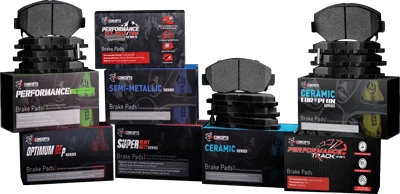
The right pad compound is the single biggest factor in how your civic brakes perform. Different compounds work in different temperature windows, and picking the wrong one for your driving style means poor performance no matter what rotor you pair it with. For a deeper look at pad materials, check out our guide on ceramic vs. semi-metallic vs. organic brake pads.
Daily Driving: R1 CERAMIC Series
Best for: LX, EX, Sport, and Si owners who commute, run errands, and want clean wheels.
The R1 CERAMIC Series pads are the best fit for the majority of Civic owners. They’re quiet, they produce minimal dust, and they deliver smooth, predictable pedal feel in everyday conditions. If your Civic is your daily driver (and for most people, it is), these are the pads you want.
Civic owners tend to keep their cars for a long time. 200,000 miles and beyond is common. Ceramic pads are gentle on rotors, which means fewer replacements over the life of the car. They also keep your wheels clean, which matters if you’re running the factory alloys or aftermarket wheels that show every speck of brake dust.
Spirited Street / Si: R1 PERFORMANCE Sport
Best for: Si owners, Sport Touring drivers, and anyone who pushes their Civic hard on back roads.
The R1 PERFORMANCE Sport pads step up the bite and heat tolerance significantly. They grab harder than ceramics and hold up under the kind of repeated hard braking you’ll do on a spirited drive through mountain roads or during a canyon carving session. For Si owners specifically, these pads unlock the potential that Honda’s upgraded brake hardware was designed for.
They do produce more dust and a bit more noise than ceramic pads. That’s the trade-off with a more aggressive friction compound. But the improvement in confidence under hard braking is immediately obvious. If you’ve ever felt your factory pads get soft after a few hard stops in a row, these solve that problem.
Track / Type R: R1 PERFORMANCE Track
Best for: FK8 and FL5 Type R owners doing HPDE and track days, plus any Civic used in time attack or wheel-to-wheel racing.
The R1 PERFORMANCE Track pads are purpose-built for sustained high-heat braking. They need temperature to work properly, which means they’re not great for a cold commute on Monday morning. But put them in a track environment where the brakes are getting hammered lap after lap, and they deliver consistent, fade-free stopping power.
Type R owners running track days should treat these as essential. The Brembo calipers on the FK8 and FL5 can generate serious heat, and factory pads start to fade after just a few hard laps. Swapping to dedicated track pads transforms the car’s braking performance in that environment. Run your street pads to the track, swap these on, and swap back when you’re done.
Best Civic Brake Rotors by Use Case
Rotors control heat management. The right rotor paired with the right pad creates a system that works together efficiently. Our drilled vs. slotted rotors comparison covers the engineering differences in detail.
Stock Replacement: R1 Blank Rotors with Geomet Coating
Best for: Replacing worn factory rotors on daily-driven Civics.
R1 blank rotors match OEM dimensions and deliver the same smooth, quiet operation as the factory parts. The key advantage is the Geomet anti-corrosion coating. Honda’s factory rotors develop rust on the hats and edges quickly, especially in humid climates or regions with road salt. Geomet-coated rotors resist that corrosion and look clean behind the wheel for years.
For most Civic owners doing a straightforward replacement, these paired with R1 CERAMIC Series pads are the smart, cost-effective choice. You get better corrosion resistance than OEM at a competitive price point. Budget-conscious Civic owners appreciate that combination.
Street Performance: R1 eLine Drilled and Slotted Rotors
Best for: Si owners and spirited drivers who want improved cooling and a performance look.
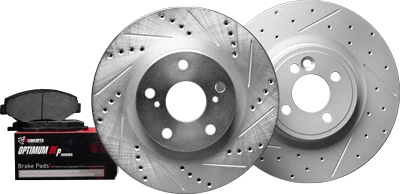
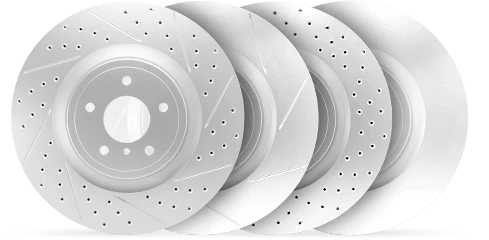
The R1 eLine drilled and slotted rotors combine cross-drilled holes for heat venting with machined slots that keep the pad surface fresh and evacuate gases. They improve wet-weather braking response and provide better heat dissipation during aggressive street driving.
For a honda civic brake upgrade that balances performance and aesthetics, these rotors paired with R1 PERFORMANCE Sport pads are the most popular combination. They look great behind the wheels and they perform noticeably better than stock during hard driving.
Track: R1 Slotted Rotors
Best for: Type R track days and any sustained high-heat use.
For dedicated track use, R1 slotted rotors are the right choice. Drilled holes can develop stress cracks under the extreme thermal cycling that track driving produces. Slots deliver the gas-venting and pad-freshening benefits without introducing those weak points. Pair them with R1 PERFORMANCE Track pads for a system built to handle the punishment of repeated high-speed stops.
FK8 and FL5 Type R owners will want the slotted option for their Brembo-equipped front axle especially. Those 350mm rotors see enormous heat loads during track sessions, and slots help manage that heat more effectively than a smooth face.
Civic-Specific Considerations
Type R Brembo Caliper Fitment (FK8 and FL5)
The Type R’s 4-piston Brembo calipers use a completely different pad shape than every other Civic trim. Standard Civic brake pads will not fit a Type R. When ordering honda civic brake pads for an FK8 or FL5, you must select pads specifically designed for the Brembo caliper. This is the most common fitment mistake on Type R brake orders.
The good news is that R1 Concepts carries pads in the correct Brembo fitment for both generations. Just make sure you’re specifying Type R when you shop.
Si vs Base Brake Differences
On the 10th gen, the Si had larger front rotors (282mm vs 262mm), which means Si-specific front pads and rotors. Don’t order base-model parts for an Si or vice versa. On the 11th gen, the Si and base trims share the same rotor dimensions, so the hardware is interchangeable. The factory pad compound is different, but aftermarket pads are the same part number across those trims.
The Importance of Proper Bedding
New pads and rotors need to be broken in correctly. Skipping this step leads to uneven pad material transfer on the rotor surface, which causes vibration, pulsation, and uneven wear. It takes about 15 minutes of controlled stops and makes an enormous difference in how your new brakes perform and how long they last. Follow our complete brake bedding procedure guide for the full step-by-step process.
Budget-Friendly Approach
Civic owners are practical. You don’t need to replace everything at once if money is tight. Pads wear out faster than rotors, so starting with a quality pad upgrade is the most impactful change you can make. If your rotors still have life left (no deep scoring, no significant lip, within thickness specs), new pads alone will transform how the car feels under braking. When the rotors do need replacing, upgrade then. Our guide on how much a brake job costs breaks down the numbers so you can plan ahead. And for timing, check out when to replace your brake pads to know exactly when it’s time.
Quick Reference: Civic Brake Pad and Rotor Recommendations
| Use Case | Recommended Pads | Recommended Rotors |
|---|---|---|
| Daily driving / commuting | R1 CERAMIC Series | R1 Blank Rotors (Geomet coated) |
| Spirited street / Si back roads | R1 PERFORMANCE Sport | R1 eLine Drilled and Slotted Rotors |
| Mixed street and occasional AutoX | R1 PERFORMANCE Sport | R1 eLine Drilled and Slotted Rotors |
| Track days / Type R HPDE | R1 PERFORMANCE Track | R1 Slotted Rotors |
| Budget-friendly daily upgrade | R1 CERAMIC Series | Keep existing rotors (if still in spec) |
Frequently Asked Questions
How long do Honda Civic brake pads last?
It depends entirely on driving style and pad compound. A daily-driven Civic on ceramic pads can see 50,000 to 70,000 miles easily. Civics are light cars, and light cars are easier on brakes. An Si driven aggressively on performance pads might go through a set in 25,000 to 35,000 miles. Track pads on a Type R can wear down in a single weekend of hard lapping. Check your pad thickness regularly and replace before you hit the wear indicators.
Can I put Type R brakes on my base Civic or Si?
Technically, a Brembo big brake swap is possible, but it’s a significant project. You’d need the calipers, brackets, larger rotors, specific pads, and likely different wheels to clear the bigger calipers. For most Civic owners, upgrading the pads and rotors within your existing caliper setup gives you 80% of the improvement at 20% of the cost. The better move for an Si is high-quality performance pads and drilled and slotted rotors, not a full caliper swap.
Do I need different brakes for the Civic hatchback vs sedan?
No. Honda used the same brake hardware on both body styles within each trim level. A 2022 Civic Sport Hatchback uses the same brake components as a 2022 Civic Sport Sedan. Just match your year, trim, and engine, and you’re good.
Are aftermarket brake pads safe for my Civic?
Absolutely. Quality aftermarket pads from established manufacturers like R1 Concepts meet or exceed OEM friction standards. In many cases, they outperform factory pads because they’re formulated for a specific purpose (daily comfort, street performance, or track use) rather than the “good enough for everyone” approach that OEM pads take. The key is choosing the right compound for your driving style.
My 10th gen Civic LX has rear drums. Can I convert to rear discs?
It’s possible but usually not worth the cost on a base LX. The conversion requires rear disc brake knuckles, calipers, brackets, rotors, pads, brake lines, and a proportioning valve adjustment. For a daily-driven LX, upgrading the front pads and rotors makes a much bigger difference in stopping performance since the front brakes do roughly 70% of the work. Put your budget into the front axle where it counts most.
Ready to upgrade your Civic’s brakes? Shop R1 Concepts brake kits matched to your exact year, trim, and engine. Enter your vehicle info for a guaranteed fit.